
403: "Disturbing" Allegations of Cheating in CUNY Medical School Program
Plus, the fun of reading academic integrity cases. Plus, what's wrong with Australia's news media? Plus, what's wrong with Australia's news media?
Subscribe below to join 4,932 (+15) other smart people who get “The Cheat Sheet.” New Issues every Tuesday and Thursday.
The Cheat Sheet is free. Although, patronage through paid subscriptions is what makes this newsletter possible. Individual subscriptions start at $8 a month ($80 annual), and institutional or corporate subscriptions are $250 a year. You can also support The Cheat Sheet by giving through Patreon.
Cheating Allegations in City University of New York (CUNY) Medical School Program
CBS News in New York City has the story of alleged cheating in a CUNY program designed to take students from high school to an M.D. The TV segment is about four and a half minutes long and may be worth your time.
The summary is that several students in CUNY’s medical program have been accused of cheating. Two students interviewed by the station deny cheating. No one should expect otherwise.
According to the report, the allegations are that students sat for an exam (what we presume was an in-class or supervised assessment), left the exam room early, then logged in to the exam remotely. That’s probably, quite clearly, not allowed — or it should not be. It also seems rather easy to prove.
Distressingly, the coverage says the students accused of cheating were offered a resolution — taking an ethics course.
The segment interviews a lawyer, who says:
“In some instances, students may have been leaving within 15 minutes of the start of the exam”
The lawyer continues:
“That should absolutely be a red flag”
About the ethics course resolution for accused students, the same lawyer says:
“In most cases, in medical schools, if you admit to cheating, the school will dismiss you”
Continuing, in A+ lawyer-speak, he says the resolution is:
“ …not altogether consistent with what would typically take place”
CBS describes the cheating in this program:
It seems to be pretty frequent, according to records
They say as well that:
In one class alone, over the course of three months, students allegedly attempted to cheat more than 50 times
All I have to say is — future doctors.
Fun of Reading Academic Integrity Cases
The student paper at the University of Toronto reports that, at their school, summaries of academic integrity cases are available online.
Who knew?
Without personally reading a single one, I can tell you every school should do this. Not just for amusement, but because few things limit attempts to cheat more than the likelihood of being caught. Showing that people are caught, in other words, matters. Sprinkle in a dash of potential embarrassment, and publishing summaries of integrity cases may, all by itself, be a reasonably effective deterrent.
Plus — you know, it’s fun. Or, as the student paper put it:
Forget Nobel prize-winning research and the discovery of insulin — U of T’s greatest gift to the world is its archive of cheating cases.
The coverage runs down five eye-roll cases from the archives. I encourage you to click over and take the journey. They deserve the click.
But seriously — why don’t more schools do this?
What’s Wrong with Australian News?
Part one.
The Australian, a well-known news outlet there, ran a story recently with the headline:
Universities watchdog warns AI cheats are ‘impossible’ to detect
Problem is, that’s not really true. Although I do note that this headline says “cheats,” not “cheating.” Still, it’s wrong. Like, factually. As in, the watchdog did not say that.
Here are the first two paragraphs, which tell us — more or less — what really happened:
Detecting cheats is “all but impossible’’ as students embrace artificial intelligence for assignments, the tertiary education watchdog has warned universities, while demanding “rigorous scrutiny’’ of exams.
Sounding the alarm over the academic integrity of online assessments, the federal government’s Tertiary Education Quality and Standards Agency appears to have thrown in the towel in the battle to ban AI cheating in assignments.
So, the headline says “impossible.” The actual warning was “all but impossible.” So, possible, in other words. Just very difficult. Completely different thing.
But more significantly, and unbelievably, this warning relates only to “online assessments.” The headline omits this crucial detail, leaving readers with the idea that the government says it’s 100% not possible to catch people using AI to cheat. What they actually said was that, in online assessments, it is very difficult to catch people cheating with AI.
Further, if you read the article, it’s clear that the concerns of TEQSA center on “deepfakes” as much as generative AI. But seeing “AI cheats” in the headline, a reader misses this distinction as well.
Here is the coverage of the warning itself, in quotes, from TEQSA:
TEQSA says “the viability, integrity and validity of assessment activities conducted in digital environments remain significant concerns’’.
In. Digital. Environments.
I don’t understand why writing a factual headline in Australia seems to be such a challenge.
To be clear, the agency does also point to the challenges of detecting AI-created work “with certainty,” saying:
“Since detecting gen AI use with certainty in assessments is, at this point, all but impossible, we need alternative approaches to complement academic integrity processes.”
With certainty. All but impossible. Standard English meaning: it’s very, very hard to pinpoint AI use in assessments with complete confidence. And, you know what? It is. Certainty is a very high standard. Higher than most criminal courts around the world, in fact. And not at all the standard most schools use in determining cases of academic fraud.
But that’s not my point — my point is that The Australian turned this very reasonable point about the difficulty of catching AI use in online assessments into catching AI cheaters cannot be done.
I mean, I do not know what to say. The headline is untrue.
To underline my earlier point a bit more, it’s clear that TEQSA is making this warning in the context of online courses and assessments:
TEQSA flags concerns over “asynchronous’’ assessments, which are flexibly timed and usually unsupervised, as well as online assessments and tests. “The ability (for) any task submitted asynchronously and/or undertaken digitally to assure that learning has occurred, now needs to be rigorously scrutinised, given the capabilities of gen AI tools,’’ it says. “Degree programs dependent on fully online or asynchronous assessment should also be carefully considered, given the rapid evolution of gen AI capabilities.’’
This is fair and, for my money, dead-on true.
My scheduled presentation to the Online Learning Consortium next month is titled, “Are Online Assessments Securable?” I should just put up that paragraph and go home.
But this is a mile and change from saying AI cheats cannot be caught.
What’s Wrong with Australian News?
Part two.
In the last Issue, we looked at The Australian Broadcasting Corporation 100% misrepresenting a headline, and the very facts, of their coverage. Here is what ABC wrote:
University wrongly accuses students of using artificial intelligence to cheat
As we pointed out, there is not one word in their article to substantiate that declaration. As we also pointed out, this was dangerous because false information such as this tends to be repeated by those who can’t do their own work and don’t bother to read the actual story.
To which, I give you this story in Futurism, with the headline:
University Using AI to Falsely Accuse Students of Cheating With AI
Nope. Still wrong.
Futurism has done this before, repeat someone’s bad coverage and somehow make it worse in the process (see Issue 217). They even did this most recent trick under the article heading, “witch hunt.”
The Australian Business Journal did not do better with their recycled story, repeating unsupported assumption as fact. Their headline:
University wrongly accuses thousands of students of AI cheating — major scandal at ACU
Also wrong.
The ABJ article, by the way — fully generated by AI, according to a reliable AI detector. Not disclosed, of course.
If you’re up for a giggle, the byline on the ABJ story is “Latest News.” No name on the story is its own signal. But, outrageously, the ABJ story says of this “Latest News” person:
I am a proficient content writer who spends most of my days writing articles and doing research. My expertise lies in the realm of technology and lifestyle. When I am not writing, I am spending time with my family in the mountains, on a continuous search for inspiration.
Come on — what are we doing?
I also particularly enjoyed the pop-up ad that greeted me on the ABJ site, an ad from cheating provider QuillBot. Like it’s poetry, here it is:
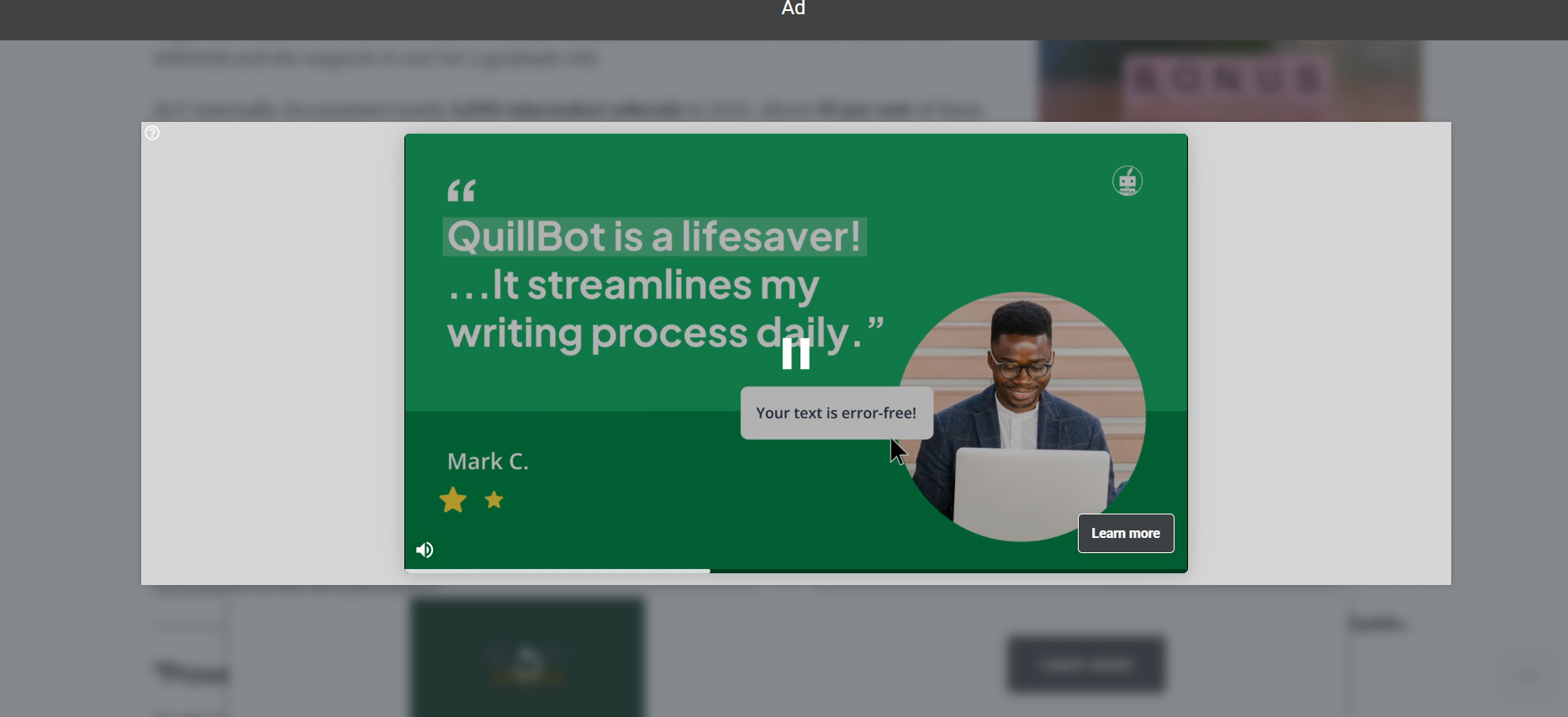
Since I mentioned TEQSA in this issue, maybe they’ll see this. Maybe that will matter since I understand that advertising academic cheating products is illegal in Australia (see Issue 138 or Issue 63).
Anyway, the irony or poetry of seeing a cheating ad over an AI-created story about a misleading story about AI-enabled cheating is just too much for me.
Canada Broadcasting Asks Students if They’re Using AI in School
The Canadian Broadcasting Corporation (CBC) ran some video asking college students about student use of AI on academic work.
It’s agonizingly predictable.
You’ll be shocked to know that not a single student went on camera for a national broadcaster to admit using AI inappropriately. They all said they used it to check grammar or brainstorm. Sure.
But they also did say, with some broadcaster prompting I am sure, that the rules for AI use in their schools and classes were unclear. As I have said before, like they are, in fact, deeply unclear whether submitting a paper entirely constructed by ChatGPT is allowed or not.
Have you seen the situation in Tampa? https://www.wfla.com/news/hillsborough-county/firings-continue-in-hcso-academic-cheating-probe-2nd-captain-let-go/
It's interesting how they tried that. What if loggs were erased?